DECEMBER 2025
Bangladesh might not be most people’s first choice of holiday destination, but then most people have never heard of a Masked Finfoot. This bizarre bird, looking like a cross between a duck and a grebe, used to be widespread across south-east Asia and relatively easy to see. Now, as a result of habitat loss and hunting, its numbers have crashed and it is dangerously close to extinction. With an estimate of fewer than 300 individuals left, it has disappeared from nearly all of its former range and the last few are mainly to be found in Bangladesh. This is a real ‘last-chance-to-see’ species. If you want to see one, and I realise most people probably don’t, it has to be soon and it has to be Bangladesh.
As well as the finfoot, Bangladesh holds a wealth of other wildlife including species that are highly range-restricted or difficult to see elsewhere. Add a warm and welcoming population, a varied and spicy cuisine, and a chance for adventure in a country that few other people will have visited, and the nation is slowly carving itself a niche in the nature tourism sector.
I jumped at the chance to visit when a team of young Dutch birders advertised online for extra participants to make up a group of six for a week-long tour. When I was kindly invited along, they probably didn’t realise I was more than twice their age and they would be looking after a decrepit old man for a week. Hopefully I wasn’t too much of a burden. I did manage to keep up with the group, and nobody had to physically carry me at any point. I even managed to find the occasional new bird for the group.
SUNDAY 7TH DECEMBER
Our tour was ably led by Zaber Ansary, our local guide from BirdingBD. Two of us arrived at Dhaka airport a few hours before the rest of the group and were taken to Purbachal to bird an area of cattle-grazed grassland with a river and small patches of wetland on the outskirts of the capital. In a short time, I scored my first three lifers of the tour: Fulvous-breasted Woodpecker, Blyth’s Pipit, and Bengal Bushlark. Other birds seen here included some stunning Bronze-winged Jacanas, Indochinese Roller, Red-wattled Lapwing, Yellow-wattled Lapwing, Long-legged Buzzard, White-throated Kingfisher, Pied Kingfisher, Yellow-footed Green Pigeon, Long-tailed Shrike, and Brown Shrike, as well as many more of the common and widespread birds of the Indian sub-continent: Black Drongo, Asian Palm Swift, Black Kite, Brahminy Kite, Paddyfield Pipit, Richard’s Pipit, Little Cormorant, Grey Heron, Little Egret, Medium Egret, Asian Pied Starling, Indian Pond Heron, Spotted Dove, Red-vented Bulbul, Jungle Babbler, Oriental Honey-buzzard, and Common Kestrel.
A WhatsApp message told us that the rest of the group had arrived at the airport and we set off to pick them up. The remaining four had flown in from a successful week-and-a-half of birding in India, mostly around Rajasthan. We squeezed into the vehicle and headed off south through Bangladesh’s often horrendous traffic. Four Black-headed Ibis were seen in flight, then once darkness descended the drive became a bit boring, only enlivened by the driver’s somewhat terrifying overtaking style. Apparently this is perfectly normal here, and the only way to make progress on Bangladesh’s busy roads.
Before midnight we arrived at the bustling port of Khulna and were ferried across to our houseboat where we would be spending the next five nights. Cabins were allocated and we sailed off into the night towards the Sundarbans National Park, home of the Masked Finfoot and numerous other delights.
MONDAY 8TH DECEMBER
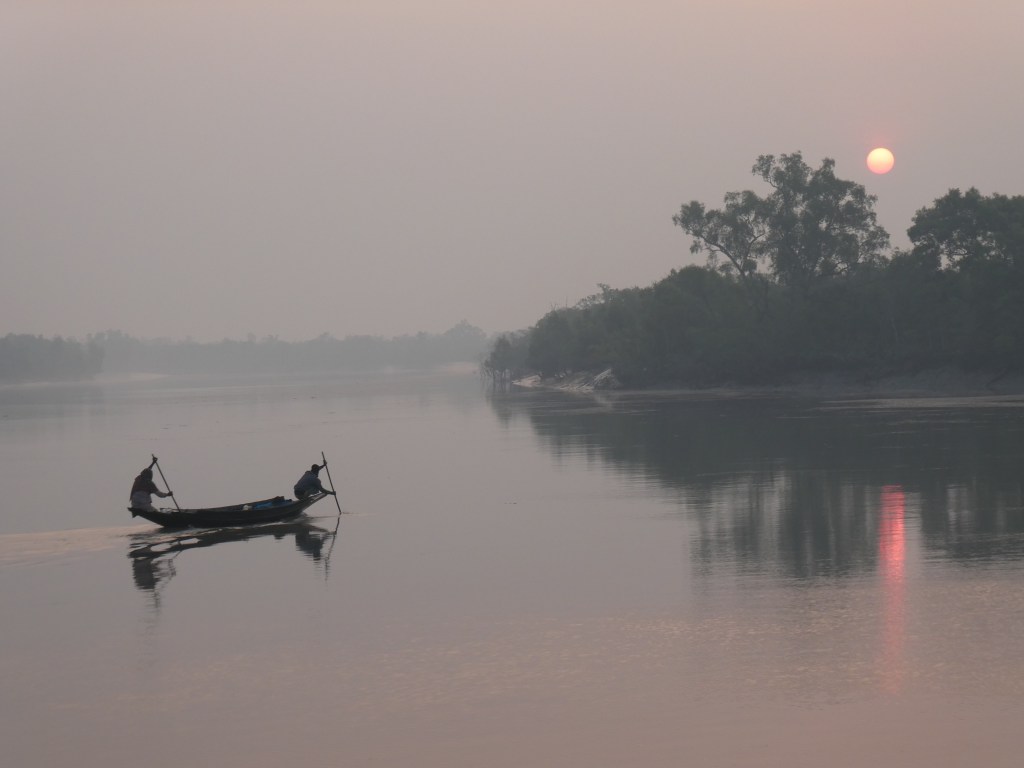
I was up early the next morning and emerged from my cabin into a scene from Apocalypse Now, as dawn broke and the boat drifted along a misty channel lined with exotic vegetation. The Sundarbans are the world’s largest area of mangrove forest and a UNESCO World Heritage Site. Ganges River Dolphins were occasionally seen, briefly breaking the water’s surface but frustratingly disappearing each time before good views or photos could be obtained. Irrawaddy Dolphins are also found here, but we failed to see any.
Great Egrets were seen along the banks and Ospreys flew overhead. Sometimes Chital (Spotted Deer) were spotted amongst the mangroves, but the Sundarbans’s most famous resident is the Bengal Tiger. Despite the world’s densest tiger population occurring here it is extremely unlikely to see one on a tour, but their unseen presence hangs over everything – from tiger pictures on all the park’s signs, to the frequently seen pugmarks in the muddy banks, and the highly cautious attitude of the locals. It is compulsory for all visitors to travel with an armed guard and, at one of our overnight moorings, the boat’s crew panicked at the sight of footprints on the adjacent bank, started up the boat, and moved hastily to a new mooring a good distance away. Sundarbans tigers kill at least two or three people per year, mostly local people gathering honey in the forest – one of the world’s more dangerous occupations.

Some smaller cats are also found here, with the Jungle Cat and Leopard Cat seen fairly frequently, and the Fishing Cat being much more elusive. Unfortunately, we saw none of these, but we did see a couple of Saltwater Crocodiles basking on the banks, numerous Rhesus Macaques, Indian Flying Foxes flapping slowly overhead, and two species of Otter: Smooth-coated Otters, and a family of Small-clawed Otters with a large male, a smaller female, and two cubs.
Our daily birding sessions were conducted in relative comfort on a small, flat-decked boat, known locally as a ‘country boat’, onto which six plastic chairs were placed. We could then putter around in the smaller creeks where the Masked Finfoot likes to hang out. On the first day we failed to find any, only some distinctive footprints in the mud, but we saw Brown-winged Kingfisher, Black-capped Kingfisher, Common Kingfisher, Lesser Adjutant, Red Junglefowl, Common Flameback, Greater Flameback, Lesser Yellownape, Grey-headed Woodpecker, Grey-capped Pygmy Woodpecker, Shikra, Ashy Woodswallow, Greater Coucal, Black-hooded Oriole, Oriental Cuckooshrike, Verdita Flycatcher, Purple Sunbird, Crimson Sunbird, Oriental Magpie-robin, Common Sandpiper, Kentish Plover, Greenish Warbler, Striated Heron, Bronzed Drongo, Indian White-eye, Cinereous Tit, Common Iora, Small Minivet, Ring-necked Parakeet, and Blossom-headed Parakeet.

As dusk approached, we went spotlighting in one of the main channels. Our main target was the White-eared Night Heron – second only to the Masked Finfoot as the most desired bird of the Sundarbans. These small, nocturnal herons are mainly found in China, where they are declining, and it was only at the end of 2022 that a very small number were found to be wintering in the Sundarbans.
Our first night bird was a male Large-tailed Nightjar flying through. Next, we heard a Brown Wood Owl calling nearby and lured it in to make three or four passes overhead before perching in a treetop and showing well.
Unlike with the finfoot, we had an amazing stroke of luck with the White-eared Night Heron, coupled with skilful technology-based tactics. The Dutch lads, who were all exceptionally good birders, had arrived for the tour fully equipped. As well as the high-end binoculars and scopes seen on all foreign birding tours, and the impressively-lensed cameras, a couple of them were armed with thermal imagers. This allowed us to drift quietly in the current with no lights shining, while scanning the banks to locate the tell-tale heat image given off by any birds or mammals lurking in the darkness. They spotted what appeared to be a small heron, and we drifted silently closer until we were at a good range to switch on the spotlight. Amazingly, we scored an adult-plumaged White-eared Night Heron on the first attempt! The bird remained in place for a good ten seconds before flying off. This might not sound like much, but normally this species flushes immediately on being spotlighted. Everyone got good views and I even managed a terrible, blurry record shot with my compact camera (the bird is just about identifiable) but the rest of the group got much better images with their superior cameras.
TUESDAY 9TH DECEMBER
Our second day in the Sundarbans started before dawn on the country boat again. On the way to stake out the finfoot creek we passed a large Buffy Fish Owl in a tree, the first of four that we saw that day. Seven Black-crowned Night Herons flew over in the dark.
While waiting in the creek for a finfoot to possibly emerge onto the mud we added a few more birds to the trip list: Abbott’s Babbler, Golden-fronted Leafbird, Dusky Warbler, Velvet-fronted Nuthatch, Speckled Piculet, Greater Yellownape, Rufous Treepie and, later, Collared Kingfisher.
With the morning ticking away, a couple of the group suggested we move around a bit more and check other locations. This paid off almost immediately when we sailed back into the main channel and one of the boat crew called out “FINFOOT!”. There on the bank was a female Masked Finfoot, not too far from where the houseboat was anchored. She retreated up the bank and into the vegetation, but soon emerged again to give us cracking views for nearly an hour and a half.
The bird flew across the channel to the other bank where we watched her as she walked cautiously around, somewhat resembling a small goose, and ate morsels from the surface of the mud. Eventually she walked down to the water’s edge and swam back across to the other side, resembling a grebe on the water (but without diving). Once back on the mud, for which her unusual feet were beautifully adapted, she disappeared back into the mangroves.
With the main target seen, much of the rest of the day was spent on the houseboat. The small vessel was comfortable but somewhat crowded, with the six of us, our guide, and around the same number of crew members, but it was a fun and relaxing place to hang out. We shared tiny two-berth cabins, and I found my bed incredibly comfortable, sleeping well every night. Being blessed with short stature, I was able to stretch out to my full 5’8’’.

Apart from a couple of picnic breakfasts on the country boat while birding, we had lunches and dinners prepared for us onboard. At least four of us (including me) struggled with the spicy Bangladeshi cuisine but, once the crew had got the measure of our culinary wussy-ness, they adapted our meals accordingly and produced an amazingly varied daily menu in such a small space in the middle of nowhere. We were so well fed that one evening we ate dinner and went to bed, only to be woken up and told that dinner was ready – the meal we had already eaten was apparently just pre-dinner snacks.
WEDNESDAY 10TH DECEMBER
After two days of birding from comfy seats on the water, we moved to a different part of the Sundarbans for some dry land birding from raised boardwalks and watchtowers. We would have to start using our legs again.
Our first location was Kalabogi, where a walk around the concrete boardwalk through the mangroves gave us Oriental Turtle Dove, Black-naped Oriole, Scarlet-backed Flowerpecker, Orange-bellied Flowerpecker, Eastern Jungle Crow, Taiga Flycatcher, Hoopoe, Common Tailorbird, Chestnut-tailed Starling, Red-whiskered Bulbul, and Pin-striped Tit-babbler. The real prize here would have been Mangrove Pitta, but our guide Zaber was sceptical that we would see one at this time of year as they do not become vocal for a few more weeks, so it was something of a shock when some of the group up ahead on the boardwalk called out “MANGROVE PITTA!”. They had spotted one low down on the mud just off the boardwalk. It perched on a stick and remained there motionless for about half an hour, giving everyone great views. Seeing any species of pitta is always a bit special.
The houseboat sailed on, and we saw more Ganges River Dolphins, six Eurasian Wigeons at a distance, an immature Grey-headed Fish Eagle perched in the mangroves, three Whimbrels flying along the channel, and a Greater Racket-tailed Drongo.
We arrived at a place called Shekhertek, where another concrete boardwalk surrounds the historic Shibsha Temple. We only had time for a brief visit as it is not permitted to be on the boardwalk after dark due to the particularly high numbers of tigers in this area. In fact, pugmarks were fairly common in the sand, as well as a set of tracks from one of the smaller cats.
At night time we did a spotlighting trip on the country boat, but failed to see anything.
THURSDAY 11TH DECEMBER
We were able to visit the boardwalk again in the morning and there was much more bird activity but, apart from a Common Redshank on the river and a White-throated Fantail, it consisted of birds we had already seen. Before walking along one area of the boardwalk, we all jumped out of our skins when the forest ranger unexpectedly fired his rifle to scare off any tigers potentially lurking, and presumably also scaring off any birds.
This area is a reliable spot for Mangrove Whistler, but it was well into the morning before I found one after I half-heartedly decided to have one last look around the temple boardwalk, not really expecting to find anything. This was by far my biggest (some might say only) contribution to the bird list and everyone got good views.
By midday it was time to start sailing north out of the Sundarbans for the long journey back to Dhaka. Along the way we saw numerous Asian Green Bee-eaters on riverside trees, three Grey-headed Lapwings flew over, and 15+ unidentified terns were seen in the distance.
As we left the national park and sailed towards Khulna, the river became wider, more industrialised, and filled with all kinds of water craft, including numerous small, overloaded ferries transporting people and motorbikes along and across the water. A string of boats piled high with large bamboo poles passed us by heading in the opposite direction.

We arrived into Khulna at 7pm and had a few hours to sleep on the boat before disembarking at midnight to spend the rest of the night driving north in the cramped car.
FRIDAY 12TH DECEMBER
Our departure from Khulna was timed to arrive at the Kamargaon Grasslands just before dawn. This is an area of mostly cultivated land, with some wilder patches and wetter areas, in the floodplain of the Padma River. The area is a known site for West Himalayan Bush Warbler, a classic Little Brown Job that breeds in a tiny area of the Himalayas and spends the winter here. As with the Mangrove Pitta, we felt our chances of connecting were slim due to the birds being silent until later in the year. In the end, one was heard and pinned down and eventually gave outrageously good views to everyone, even coming within a metre of us at one point.
Other birds seen here were Green Sandpiper, Black-winged Kite, Striated Grassbird, Plain Prinia, Asian Openbill, Baya Weaver, Bluethroat, Citrine Wagtail, White Wagtail, Eastern Yellow Wagtail, Thick-billed Warbler, Paddyfield Warbler, Wryneck, Zitting Cisticola, Jungle Myna, Bank Myna, Common Myna, House Crow, Grey-backed Shrike, Purple-rumped Sunbird, White-breasted Waterhen, Eastern Cattle Egret, Striated Babbler, Grey-throated Martin, and Chestnut Munia.
We saw a Golden Jackal foraging in the dawn light, and later were entertained by a prolonged burst of their manic howling coming from various directions and giving some indication as to how numerous they were in the area.
In a location a short walk away, it took us about an hour to pin down another target bird: White-tailed Stonechat. Zaber found a pair straight away, but it is so similar to the much more common Siberian Stonechats that we spent some time trying for a photo with the tail spread to show the diagnostic white feathers to confirm the identification.
By the time we walked back through the village to the car, the local people were up and about and our group became a source of curiosity for some, which illustrates how few western tourists make it to Bangladesh.
We drove through Dhaka and onwards to Satchari National Park in the north-west of the country. The journey was cramped and uncomfortable, and I was unable to sleep due to the bumpy roads, but eventually we made it and were relieved to get out of the vehicle. It was already dark when we arrived so, unable to visit the park, we went spotlighting instead.
Our first sighting was a mammal: a Northern Red Muntjac, but then we managed to call in two species of owl. First a Collared Scops Owl gave excellent prolonged views, and then we scored a Brown Boobook before heading off to check into a nearby hotel for two nights.
SATURDAY 13TH DECEMBER
Outside the hotel before dawn, some Indian Flying Foxes flew past heading to their daytime roosts while I waited for the vehicle to drive us the short distance to the national park entrance.
The morning was spent up a tall watchtower overlooking the forest canopy, and the new birds came thick and fast: Lineated Barbet, Blue-throated Barbet, Blue-eared Barbet, Coppersmith Barbet, Hair-crested Drongo, Ashy Drongo, Lesser Racket-tailed Drongo, Rosy Minivet, Swinhoe’s Minivet, Black-crested Bulbul, Black-headed Bulbul, Thick-billed Green Pigeon, Chestnut-headed Bee-eater, Banded Bay Cuckoo, Square-tailed Drongo-cuckoo, Grey-headed Canary-flycatcher, Oriental Pied Hornbill, Black-winged Cuckooshrike, Red-breasted Parakeet, Ruby-cheeked Sunbird, and White-rumped Shama.
The main reason for coming here though was a chance to see Cachar Bulbul – not very interesting to look at, but occurring in a highly restricted range covering the eastern edge of Bangladesh and some adjoining areas of India that are not accessible to foreigners. Fortunately, we spotted one early from the watch tower and it made regular reappearances throughout the morning. With this main target in the bag, we could relax and enjoy the spectacle in the forest canopy.
A number of primate species could also be seen at Satchari. As well as the ubiquitous Rhesus Macaques loitering in the car park, we had good views of a group of Capped Langurs in the tree tops near the watchtower, and Zaber pointed out a large male Assamese Macaque in the car park, looking subtly different from its more common cousins.
After lunch and a siesta at the hotel, we returned to the park to spend the late afternoon sitting at a pool which is known to attract a variety of birds to bathe and drink before heading to their night-time roosts. On the way there an Asian Emerald Dove flew by.
We settled in by the pool and it didn’t take long for the first birds to appear, starting with male and female Black-naped Monarchs hiding up in the underside of a bamboo clump and dive-bombing nervously into the water for a quick bath. Next came a Taiga Flycatcher and then at least four White-throated Bulbuls. Male and female Blue-throated Blue Flycatchers visited alongside a male Snowy-browed Flycatcher, male and female White-tailed Robins, a male White-rumped Shama, four Puff-throated Babblers, and two Pin-striped Tit-babblers.
An Irrawaddy Squirrel was seen in a tree, some Common Hill Mynas flew over the forest clearing followed by an unidentified nightjar, and then the show was over as darkness set in.
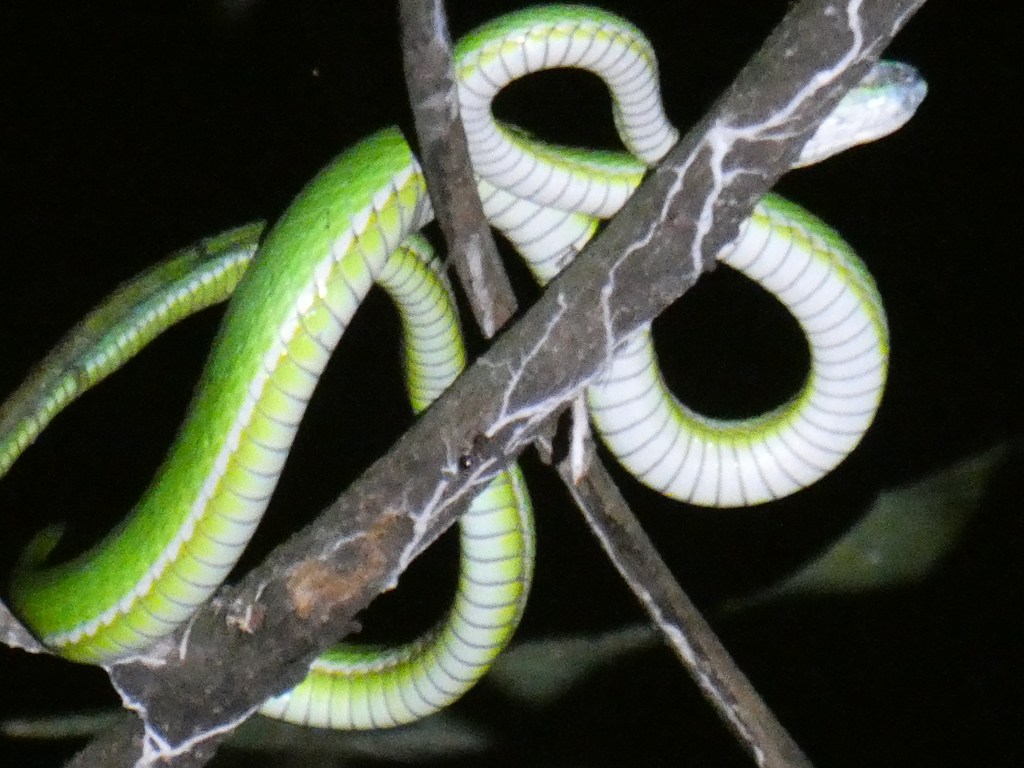
We tried another spotlighting session but no night birds were seen. Two Asian Barred Owlets were heard calling but remained hidden in foliage, and the only animals of interest were some kind of civet seen briefly by some, and a bright green snake in a tree that was later identified as a White-lipped Pit Viper – deadly venomous, apparently.
SUNDAY 14TH DECEMBER
Our final day in Bangladesh allowed half a morning back in the park to look for shy White-cheeked Partridges along the forest trails. One was heard calling and it responded to playback, coming cautiously closer but remaining frustratingly out of view for most of the group. Only two people got brief glimpses and unfortunately I wasn’t one of them.
We also had a go at tape-luring Blue-naped Pitta, but it seems we had used up all our pitta luck in the Sundarbans and we didn’t even get a response. Asian Barred Owlet was heard again, and a Wild Boar was seen on the way in.
The best sighting of the morning for me was a family of Western Hoolock Gibbons, another of Satchari’s primates and the only ape in the Indian sub-continent. We first heard them vocalising some distance away but couldn’t get a sighting. Further along the trail a family was seen in a nearby tree, the male with all-black fur and striking white eyebrows briefly swinging from the branches, and a pale-brown female carrying a baby.
We drove back to Dhaka for the last time and made a brief stop at Purbachal again before heading to the airport. My final tally was 162 bird species, with 28 of them being lifers, 14 species of mammal (six lifers), and two reptiles (one lifer). The group list was slightly higher, with me having missed a few birds seen by others.
Thanks to:
Zaber Ansary for guiding the tour:
And to:
Casper, Danny, Jaap, Jasper, and Vincent for letting me tag along.

 Vole Explosion
Leave a comment