I wouldn’t normally expect to see seals this far inland, and I was surprised the first time I saw one swimming in the River Great Ouse in the landlocked county of Cambridgeshire. That was in late January 2016, and my first instinct identified it as a European Otter, before quickly realising that it was much too big. Once I got a good view I was amazed to see it was a Harbour Seal… in a river, surrounded by farmland, and 35 miles (57 km) in a straight line from the nearest sea.
It was clear that the seal must have swam here from The Wash (the large North Sea estuary separating Norfolk from Lincolnshire) and navigated along the river and the man-made channels dug in the early 17th century to drain the Fens – a distance of 40 miles (65 km) past villages and locks via the shortest route. Maybe not a huge distance, but I wasn’t aware that this was something a marine mammal would do, and so I assumed it was a one-off – a lost individual that had taken a wrong turn and ended up in the river system.
Fast forward to October 2021 and again I saw a seal in the same spot. So it was either the same animal that had now settled in the area, or Harbour Seals were regularly finding their way inland.
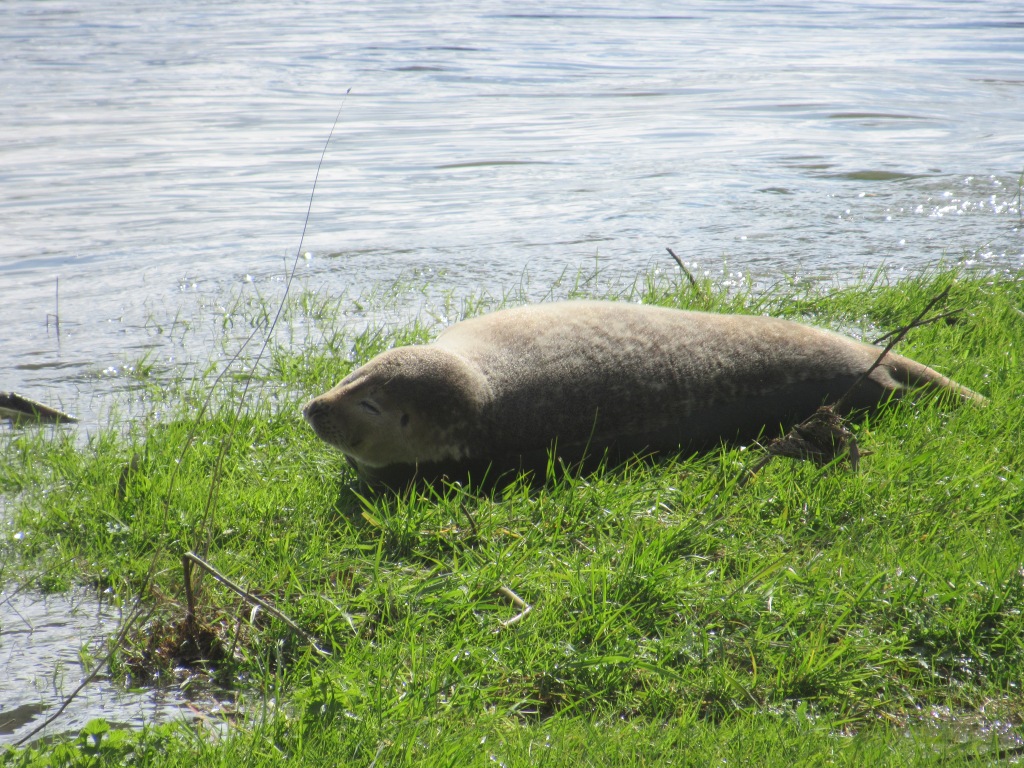
On Easter weekend this year I had a third sighting in the same place, and this time the seal was hauled out on land, allowing me to get some photos.
The river level was high due to recent rain and the seal was an incongruous sight, loafing on its small, grassy island, but at the same time it appeared completely relaxed and at home, not in the least bit bothered by walkers and cyclists passing by over the lock bridge. The general area is fairly quiet, located on the river between the RSPB’s large nature reserves at Ouse Fen and Fen Drayton Lakes but, as the only crossing point for a few miles, it is rarely completely deserted here.
I did a bit of research online and found that seals have been reported in Cambridgeshire for many years now, but their presence has not been widely known. The creation of the nearby nature reserves has led to a growing influx of birders into the area who are inclined to also record and report interesting mammal sightings. There is a cluster of sightings in the area around the lock, as well as a second cluster on the River Nene near Peterborough. This is the other river that flows into The Wash, so the seals are finding their way into both river systems. The presence of flipper tags on several individuals confirms that they do indeed originate in The Wash.
Comparison of digital images has revealed that some individual seals have been resident for many years, while others are more transient. The permanent residency of these seals, as well as the observation of animals in the water thought to be babies, raises the possibility of breeding away from the coast. This was confirmed in 2014 when a mother suckling a pup was photographed on the river bank.
So it looks like the small population of inland Harbour Seals may be here to stay and, as I visit the area fairly often, I hope for many more sightings in the future.
References:
 Vole Explosion
Leave a comment