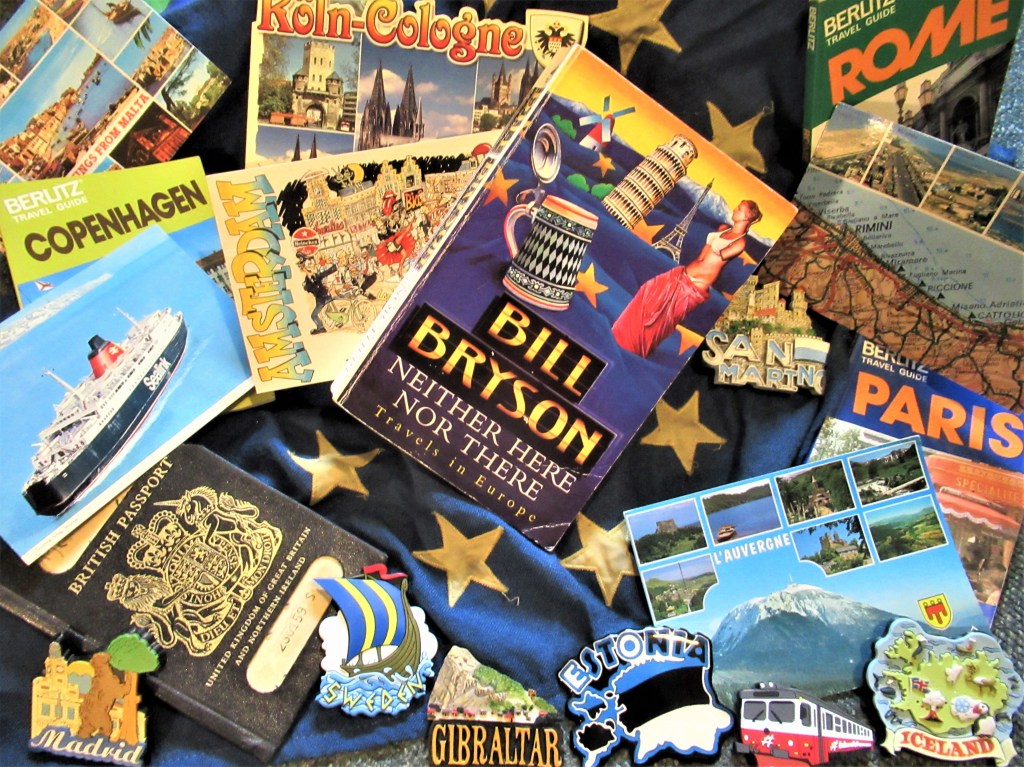
NEITHER HERE NOR THERE: TRAVELS IN EUROPE
Bill Bryson (1991)
If you have any interest at all in travel writing then Bill Bryson will already be familiar to you. He is one of the most popular and recognisable authors in the genre, and in Neither Here Nor There he turns his eye towards continental Europe.
Starting with a prolonged trip to Arctic Norway to see the Northern Lights, he is then inspired to embark upon a journey around the rest of Europe, sometimes following a plan and sometimes making spur-of-the-moment decisions to jump on a train and head off somewhere new when he isn’t enjoying his current location. His mood and opinions vary with each new city or country. Some he views negatively – Brussels, Cologne, Geneva, Sweden – and others he adores – Paris, Denmark, Bruges (and the rest of Belgium outside of Brussels), Innsbruck, Vienna and, especially, Italy, to which he dedicates fully one fifth of the book. His criticisms always seem fair and well-reasoned, without ever tipping over into outright xenophobia, and only occasionally into national stereotypes. Generally he is far more critical of his native USA and his adopted country of England, both of which he frequently compares unfavourably with mainland Europe. His love of the continent is obvious, and he seems to get a kick out of the way European nations are all so different from one another, yet still so unmistakably and cohesively European.
Throughout the book, Bryson reminisces about a previous trip to Europe that he made as a teen in the early 1970s, accompanied by his friend from back home in Iowa, Stephen Katz (perhaps better known as his hiking companion in his later book A Walk in the Woods). As he revisits his old haunts from twenty years ago, he throws in humorous anecdotes from this earlier trip, as well as other moments from his past such as his honeymoon in France or his school days.
Nostalgia plays a large part in the narrative, as he notes how much Europe has changed since he was last there, and this was reflected by my own nostalgia as I read it. At the same time that Bryson was wandering around Europe for this book, I was Inter-railing around the continent for four months. This was one of the most memorable and enjoyable times in my life, and I tend to look back on it in the same rose-tinted way that the author looks back on his own early travels.
1990 was an amazing time to be travelling in Europe. Communism had collapsed only a few months previously and things were already changing fast. The continent still contained Czechoslovakia, Yugoslavia, and the Berlin Wall, and every country still used its own currency. Early versions of mobile phones and the internet existed, but neither had entered the lives of the vast majority of us, and it would be at least another decade until they became ubiquitous. In the early 90s all travel arrangements and transactions still had to be made face to face over a counter, or via a landline.
It was about a decade after its 1991 publication that I first read Neither Here Nor There. Back then it still felt contemporary, and the world it described was more-or-less the world in which I still lived. While the 70s and 80s now seem fairly distant to me, the last three decades (ie, my adult life) still feel recent. So I was slightly taken aback on re-reading this book to realise just how much travel has really changed. The pages are full of references to things that were perfectly routine in the 90s but now seem like quaint customs from a bygone age:
- Booking flights at the travel agents,
- Going to the tourist information centre to find a hotel room,
- Smoking in restaurants,
- Video cameras and Polaroid photos,
- Cashing travellers’ cheques at the bank,
- Trains with compartments,
- Flicking through the Thomas Cook European Timetable, with the sound of a mechanical railway departure board clickety-clicking in the background.
At times the book almost feels like it is describing the Grand Tours of the Victorians and Edwardians, rather than an era that still feels fresh in my memory. Bryson even indulges in some occasional light-hearted lechery that nowadays might have trouble getting past the sensitivity readers at his publishers.
The world of travel has slowly shifted under my feet and I had barely noticed it happening from one year to the next. Reading Neither Here Nor There again has really brought it home for me.
But as well as being a (Polaroid?) snapshot of its time, this is also a highly entertaining read filled with humorous observations of the absurdities, frustrations and small indignities of travel, always described in a comically exaggerated manner. Bryson is usually at his funniest when things are going wrong. Mostly, though, this book is a celebration of the joys of being alone in new and strange places, with time on your hands and some money in your pocket, and not fully knowing what’s going on around you. As a quote from early on in the book puts it:
“I can’t think of anything that excites a greater sense of childlike wonder than to be in a country where you are ignorant of almost everything. Suddenly you are five years old again. You can’t read anything, you have only the most rudimentary sense of how things work, you can’t even reliably cross a street without endangering your life. Your whole existence becomes a series of interesting guesses.”
Bill Bryson: Neither Here Nor There
The internet may have taken most of that guesswork out of travel, but the excitement and childlike wonder can still be found out there, and crossing the street in some European cities is still a bit risky.
Bill Bryson has written fascinating and entertaining books on a variety of subjects and has now more-or-less retired. I only wish he had written more travel books first
 Vole Explosion
Leave a comment