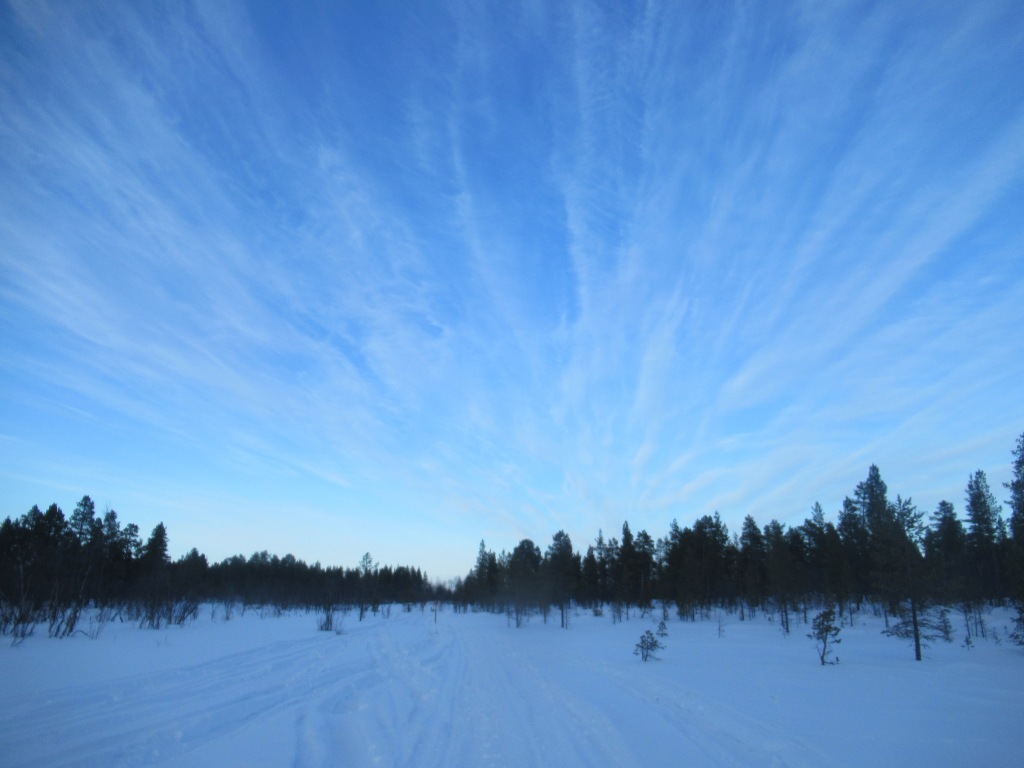
NORTHERN FINLAND
2nd – 5th March 2023
This isn’t my first trip to the Arctic. In 2019 I rode the Inlandsbanan, a slow summer train that runs through the centre of Sweden and stops as it crosses the Arctic Circle so that we could step down and take photos before continuing on to Gällivare at the end of the line. From there I spent a few days at the wonderful Abisko National Park.
This time I fly over the Arctic Circle to Ivalo in northern Finland and I’m already about 15 miles (24 km) further north than I’ve ever been before. Last night I flew into Helsinki and spent the night at the airport. This is my first trip to the EU since the Brexit rules kicked in and I now need to get my passport stamped. I was questioned about why I had come to Finland, how I was getting around, and whether I had booked my transport and accommodation. I also had to show proof of reservations, which fortunately I had as I’d booked everything in advance and printed it all out. I hope she wasn’t too disappointed that all my papers were in order, and I wonder what would have happened if I had just booked a flight and arrived with no reservations, like I normally do. I’m mildly thrilled at getting a European stamp in my passport for the first time in thirty years. It briefly feels like the early 90s again and I’m young and slim and Inter-railing around Europe. Not sure my warm feelings of nostalgia can be classed as a Brexit benefit though. I didn’t vote for any of this. In fact I voted for the exact opposite.
Once into the airport I find the public toilets are playing birdsong, which is obviously brilliant.
Early next morning I fly to Ivalo and already feel like I’m hitting the north when the plane is de-iced before take-off. Ivalo is tiny and the airport is about 6 miles (9.6 km) from town. I’m not planning on any hiking on this trip, but my bus isn’t due for another four hours, so I decide to walk in along a foot/cycle path. It is covered in compacted snow but isn’t slippery, so the walking is easy and I see the first birds of the trip: a couple of Hooded Crows, many Great Tits singing along the roadside, at least six Great Spotted Woodpeckers, five each of Blue Tits and Magpies, and a pair of Eurasian Jays.
House Sparrows are common in Ivalo itself.
Part of the road follows a broad, frozen river and a group of snowmobiles speed along it in a line. Further on I see a large team of sled dogs resting on the ice.
After lunch in Ivalo I catch the bus and travel north through snow-covered pine and birch forest, past frozen rivers and lakes, to Neljän Tuulen Tupa. A female Capercaillie is standing in the road and doesn’t flush even when the minibus swerves around it.
Neljän Tuulen Tupa is a roadside guesthouse in the forest, pretty much in the middle of nowhere. The name means ‘cabin of the four winds’ and my room here has a cosy log cabin vibe. They rent out actual cabins during the summer season, but as it is still winter my room is in the main building. The big draw here for me is the birdlife. They have a huge feeding operation at the back of the building, with numerous feeders visible just outside the restaurant windows, making it a great place to easily see some boreal forest specialities that can otherwise be a bit tricky to find in the wider countryside. Before I have even checked in I am distracted by lifers – first a Siberian Jay, which I saw briefly once before from the moving train in Sweden, and at least ten Pine Grosbeaks. There are also double figures of Greenfinches and a couple of Great Spotted Woodpeckers. Once I’m checked in I see a Siberian Tit – another lifer – from the window of my room. That’s all three target birds (and two lifers) for this location within minutes of arrival, and I still have another two days here.
I spend the last couple of hours of daylight watching the feeders and add Bullfinch, House Sparrow, Common Redpoll, Willow Tit, Great Tit and Eurasian Jay to the list, as well as some Red Squirrels. The close views are incredible. A brief walk along the road produces a pair of flyover Ravens.
After a dinner of pan-fried salmon with potato wedges and veg., I go outside in the hope of seeing the Northern Lights, as it is a fairly clear night tonight. I hang around the car park for a while and a car pulls up containing four Indian tourists who are also staying here. They suddenly start whooping excitedly and pointing at the Aurora. At first I think they’ve mistaken a long, thin cloud running across the sky. It looks quite faint but, when I go over to where they are standing, I get a better view of the end nearest the horizon and it has a definite (and increasing) green glow that I couldn’t see before. The lady from the guest house confirms that it is indeed the Aurora Borealis, if not exactly its most spectacular manifestation.
For a better view we walk behind the building and down onto the frozen lake beside which it stands. In time the glow becomes more vivid and I get some surprisingly decent photos with my little compact camera by putting it on a tripod and using a 15 second exposure – something I had only looked up how to do the day before flying out. We spend about half an hour watching and photographing the lights until, just after 9pm, they fade away and the show is over. Not bad for my first night, and I still have another eight nights left.
The next day I get up early and go for a pre-breakfast walk in the taiga forest. Immediately I hear a Willow Grouse calling near the guesthouse. I walk in its direction and another call draws my attention to the bird at the edge of the frozen lake. A second grouse flies in to join it and then they both fly off through the trees. They are in their stunning pure white winter plumage. Surely it’s only a matter of time before these Willow Grouse are split from the British Red Grouse, which stays red all year round.
By following the compacted snow of snowmobile tracks I am able to get around easily. However, stepping off these tracks onto virgin snow usually leads to sinking up to my thighs.
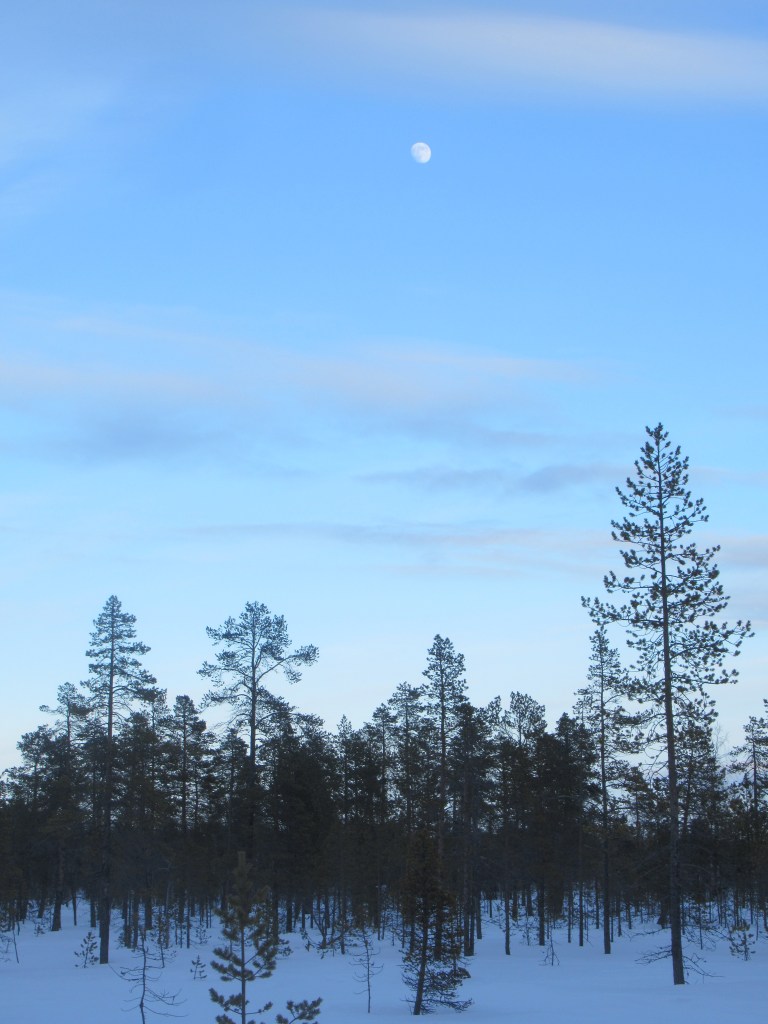
Unlike the frenetic activity at the feeders, the forest appears virtually birdless. I imagine the guest house’s Herculean feeding effort sucks in all the birds from the surrounding land for the winter. Presumably in the summer they all spread out onto breeding territories throughout the forest. I see numerous tracks of Mountain Hare and (presumably) Red Fox, and the forest itself is beautifully silent and atmospheric, with only the occasional distant plane creating any sound other than the crunching of my footsteps. The temperature is -6°c (21°F).

Back at the guesthouse there are birds again, and a large buffet breakfast. A new bird for the list is Arctic Redpoll. I thought I had some of these yesterday, but I confirm it this morning. Apart from the birds, the Red Squirrels are firmly in charge this morning, with a minimum of five seen together but probably more popping in and out. They have a pale grey winter coat here, with the red restricted to their legs, tails and ear tufts. All the same birds as yesterday are seen around the feeders, and an afternoon walk sees another four Willow Grouse flying distantly at the far end of the lake.
I find that walking across the full length of the frozen lake takes me to a path through the trees that loops around and brings me back to the guesthouse from the opposite direction, which is where I was this morning.
I stop on the lake and watch the sunset before going in for dinner. Tonight is too cloudy for any possibility of the Northern Lights.
Today is Sunday and the one bus per day doesn’t pass through until 5.30pm, so I have pretty much another full day here. I booked two nights here because I didn’t realise the birds would be so easy to find. Still, I’ve enjoyed the opportunity to spend long periods of time with these Arctic species, some of which I may never see again. With a car it would be easy to stop by for a few minutes and tick off all the target species – they are at the feeders pretty much throughout the hours of daylight – but Neljän Tuulen Tupa is a really nice place to spend at least a night. Any birders working the hot-spot of Varanger Fjord in Norway should consider setting aside a day to drive here for some boreal forest species. It’s about a two to three hour drive each way, through beautiful scenery, for a long lunch with Pine Grosbeak, Siberian Tit, Siberian Jay and Arctic Redpoll right outside the window, often less than a couple of feet from the glass.
And speaking of Varanger, that’s where I’m headed in part two. But first I have another relaxed day of backyard birding, forest walking, eating and reading before the bus arrives to take me further north to the Norwegian border near Utsjoki. The temperature has dropped to -10°c (14°F) as dusk approaches. From the bus I see three more Willow Grouse perched in a shrub and a single Reindeer by the roadside, before arriving in Utsjoki at 6.30pm. My connection in Norway isn’t until 9pm, but Norway is an hour behind Finland, so I have three and a half hours to wait in a village with not much going on. Fortunately, there is a bar-restaurant where I can get dinner and a couple of beers.
At 8.30pm I decide to leave. I’m torn between staying in the warm and going out to look for the Northern Lights. The skies are clear tonight, so chances are good, but it’s also brutally cold.
I walk north and cross the border at a large bridge across the river, quickly popping into a border post to check if I’m supposed to get my passport stamped – I’m not. Despite the full moon and all the streetlights on the bridge, I can already make out a faint green streak in the sky. Now in Norway, I continue north to the T-junction where the bus is supposed to pick me up. It’s one of those buses that you book in advance and it only operates if somebody books it.
It is darker at the bus stop layby and no sooner have I arrived when it all kicks off. A really bright green streak forms across the sky and, with frozen fingers, I try to assemble my tripod and camera, but the lights have faded a bit by the time I’m ready. I can only keep my gloves off for about a minute, and the moving parts of the tripod are freezing up. I manage only a couple of photos before the lights fade completely.
Twenty minutes later they emerge again, and I move to a darker part of the road. The Aurora is now brighter and more extensive than it was and then, quite suddenly, it goes crazy! Huge waves of light spread across the sky and form the classic waving curtains of green and pink. Most of the sky is now filled with coloured light and it’s hard to know where to look. The lights I saw two nights ago were pathetic compared to the brightness and extent of these. It’s overwhelming.
I try to take more photos, but my camera battery has been drained by the cold. I put it in my pocket for a few minutes then manage to take one crappy photo, badly blurred from holding the camera for the 15 second exposure. My fingers are now far too cold to fix the camera to the tripod, and the tripod itself is too cold to touch with bare hands. Just taking that one photo has left my fingers feeling dangerously painful, so I abandon photography, put my gloves back on, and keep my hands in my pockets. They warm up very quickly.
I have to consciously stop myself from jigging about to keep warm so that I can watch the lights more intently. They seem unreal and it’s hard to keep focused on any one part without my gaze darting around the sky as new patterns form and fade.
About an hour after they started, they fade down to a single, faintly glowing strip. Just then the minibus arrives and I climb in. Only now do I find out that the temperature is -23°c (-9°F) – as far as I know, the lowest temperature I’ve ever experienced. I sit up front and chat to the driver. He moved here from Oslo last year and says the winter took some getting used to, especially in November when it’s properly dark, before December’s snow and Christmas lights arrive. We have to stop to allow six Reindeer to get out of the way, and then I’m dropped off at the hotel in Varangerbotn at 10pm, glad to be back indoors.

 Vole Explosion
Leave a comment