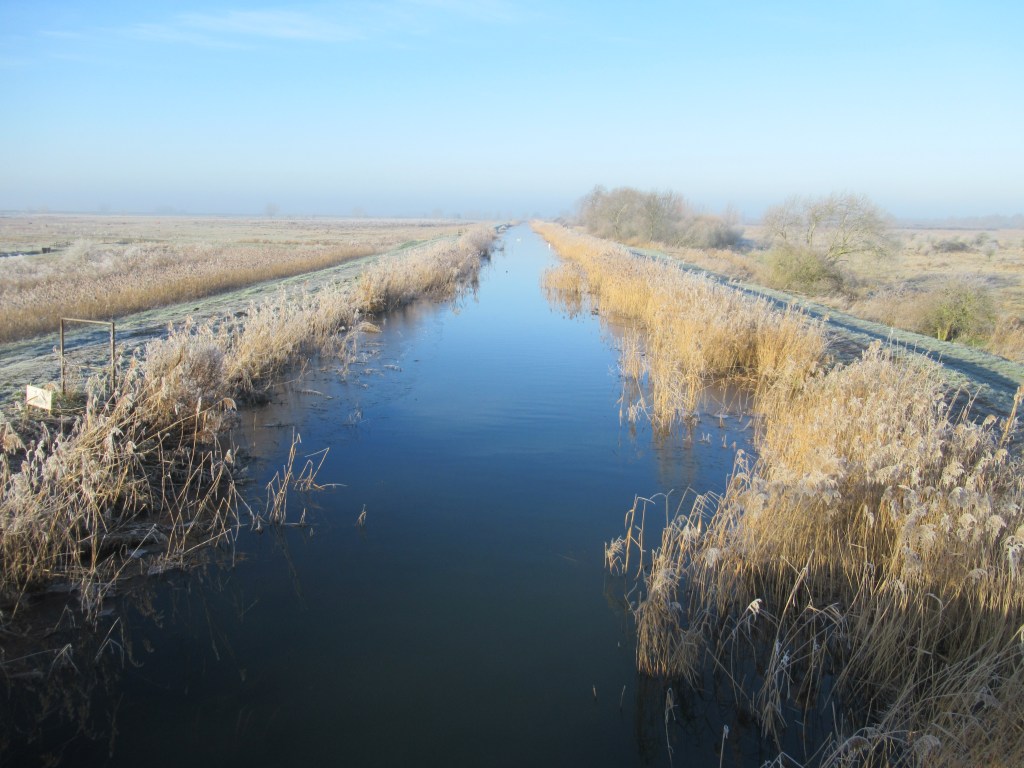
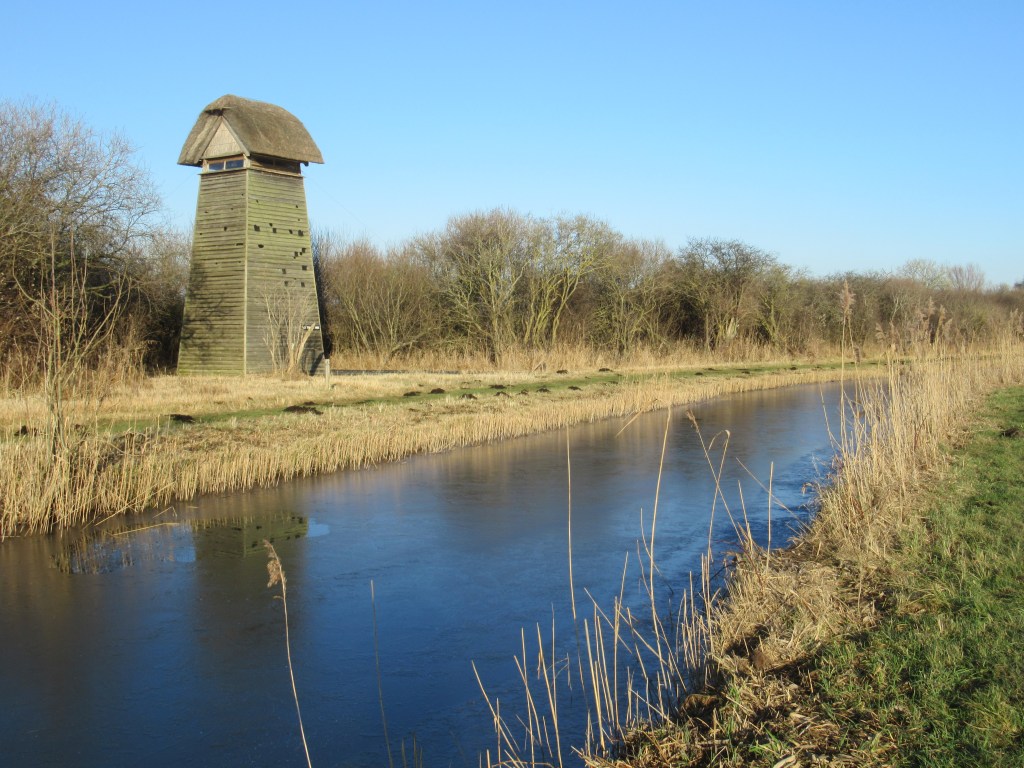
After a couple of wet weekends, I’m keen to get outdoors again and look for some wildlife. I decide to spend a day at Wicken Fen, one of Britain’s oldest nature reserves and one of only four areas of wetland left behind when the large fens of eastern England were drained for agriculture. I arrive at dawn following a cloudless night. It’s bitterly cold, everything is covered in frost and most areas of water are frozen. Within half an hour my hands are painful and already making it difficult to operate my camera or write in my notebook. I wonder if I’ll manage to stay out here all day.
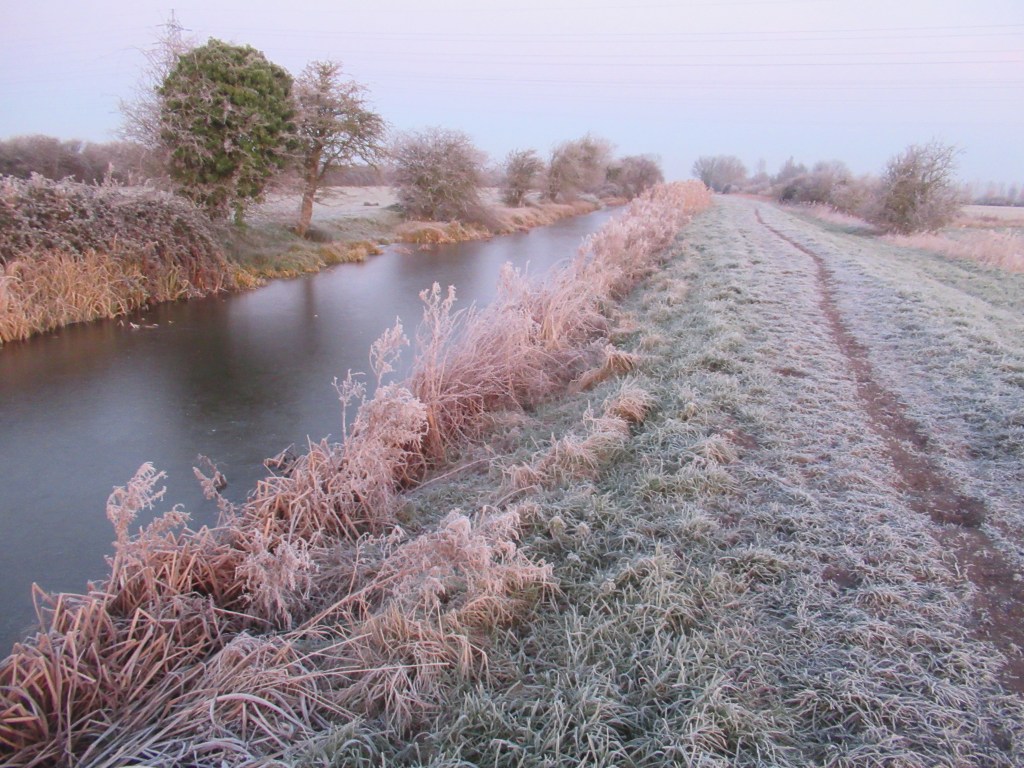
As it gets light, three Little Egrets take off from their overnight roost in some tall bushes and fly off towards the marshes. There are a few mammals around too. Mostly Roe Deer, which are incredibly common and bold around here. The reserve uses Highland Cattle and Konik Ponies as habitat management tools, and the deer can often be seen mixed in with them on the drier grassy areas, forming an attractive herd of mixed herbivores.
I see a couple of Brown Hares here as well, with one constantly following the other. Presumably a male following a female for some early courtship. The female seems relaxed about it, with none of the boxing that will be seen a few weeks later in the year.
Nearby, a Red Fox is heading away across a field. I see quite a few foxes today, sometimes crossing the frozen areas of water. The cold weather, which is bad news for most of the animals, is probably beneficial to these scavengers, who will be out looking for any individuals weakened or killed during the night-time freeze.
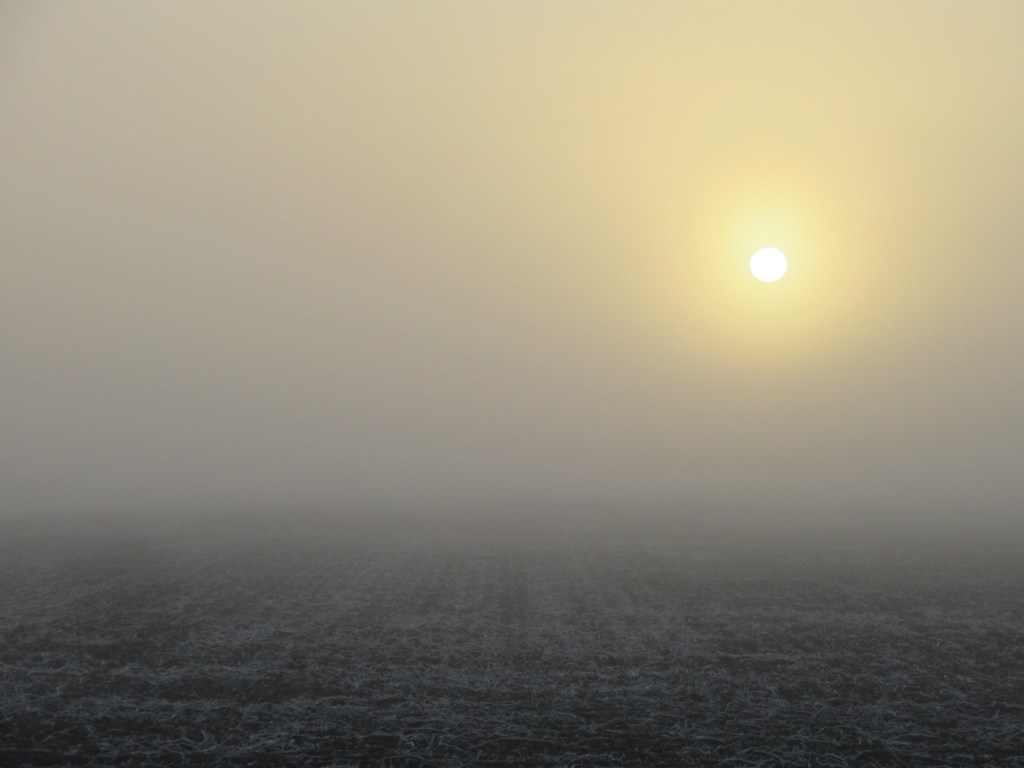
Not long into my walk, a thin layer of fog forms, adding to the atmosphere, but reducing visibility to about fifty metres all around me. The sky above it is already bright blue. I can’t see much, but I can hear the whistling calls of Wigeon and the chacking of Fieldfares, both signature sounds of winter in the Fens. Suddenly there is a commotion out of view in the mist and the ducks have been put into the air in a panic. A minute or so later I see why when a Marsh Harrier comes drifting out of the gloom. It’s dark bulk and slow flight give it an intimidating air as it emerges from the pale grey backdrop. They’ll be more of these marshland hawks later.
I was hoping to see some owls this morning, but chances are slim until the fog lifts. Wicken is a great place to see owls. I expect all five regular British species occur here in winter. Barn Owls and Little Owls are resident and easy enough to see, and I’ve seen Tawny Owls here on occasion. I once found an elusive and highly nocturnal Long-eared Owl just off the reserve and I’m sure at least one must be here most winters, either roosting by day or hunting by night. But it is Short-eared Owls that are something of a speciality here. In the UK, these breed mostly in the uplands of Scotland, Northern England and Wales, but in winter they descend to lowland marshes inland or at the coast. Our resident birds are boosted by owls from northern Europe that migrate across the North Sea in varying numbers each year. This is dictated by the boom and bust cycles of rodent populations. If the owls have a successful breeding season, followed by a crash in vole numbers, many will cross over to the UK searching for food. In other years there may not be many at all. I have seen double figure counts at Wicken in the past, but this winter only one or two have been reported. There are usually a few photographers with giant lenses near the Short-eared Owls’ favoured spot, hoping to get some shots of these charismatic, day-flying predators, and today is no different.
A Common Buzzard perched on a fence post in the gloom is being dive-bombed by a feisty little Kestrel. It’s also upsetting the local, vocal Lapwings. While I’m watching it, a guy with a camera comes over and asks me if it’s an owl. There has been a huge increase in the last few years of bird photographers who have no idea what they’re photographing. Mind you, I’m a birder who sucks at taking photos, so I probably shouldn’t be too critical. Having said that, if you’ve spent a lot of money on a camera and lens, and have gone out specifically to photograph owls, it might be advisable to familiarise yourself with what an owl looks like. Google is your friend.
The only owl I see today is a single Little Owl sitting in its usual spot on a log pile where a breeding pair resides. Little Owls are highly sedentary and don’t appear to really do much, so if you find one perched up somewhere, there’s a good chance it will be perched up in the same place every time you visit. Very little moves on a Little Owl except its head. Sometimes it will stare at you with yellow eyes and a grumpy expression, and sometimes it will pretend to stare at you with the fake ‘eye’ markings on the back of its head.
The sun is trying to shine through the fog, and I decide to go to a nearby hide to eat the breakfast sandwiches I’ve brought along. By the time I’ve finished the fog has cleared, leaving a clear blue sky over a frosty landscape. There is no hint of a breeze and the light from the low sun is really beautiful. The muddy paths are frozen, making walking easy, and there aren’t too many people around on most of the reserve away from the car parks. Wicken Fen can get very busy at the weekend. I first started coming here in the 80s and, in winter, I pretty much had the whole place to myself. Back then only people interested in nature visited nature reserves, but nowadays most are filled with dog walkers, mountain bikers and joggers, most of whom don’t really understand what a nature reserve is for and just treat it like any other park or playground, as a place to shout, let off steam, and let their dogs run free to harass the wildlife. Personally, I blame Springwatch!
Back when I first visited, the reserve was much smaller, and I struggle to remember how I managed to fill a whole day here. Since then the area protected and managed by the National Trust has grown massively. They have a 100-year project to gradually buy all the agricultural land in a huge wedge, from the current reserve all the way to the outskirts of Cambridge, and convert it back into wetland. This started off well, with some fantastic new habitat created, but it’s been years since they bought any new land and I doubt much more will be achieved in my lifetime. Enormous new farmhouses have been built on some of the intended land, so I can’t see the owners selling up any time soon.

Now that the fog has cleared and I can see the landscape, I notice that all the ducks and Coots are concentrated in small areas of unfrozen water. All the usual dabbling duck suspects are present: Mallard, Wigeon, Teal, Gadwall and Shoveler. I don’t see any of the scarcer winter ducks, nor any diving ducks.
There are plenty of decent sized flocks of winter passerines around the reserve: Fieldfares, Redwings, Goldfinches, Meadow Pipits and Reed Buntings, the males of the latter starting to come into breeding plumage.
Walking around, I hear the piglet squeals of Water Rails hidden in the reedbeds. Frozen conditions can often force these normally shy birds into the open, but I don’t see any today. Another unseen skulker, the Cetti’s Warbler, gives occasional bursts of its explosive song from deep cover. These small birds stick around all year, toughing out the winter while most other warblers have flown south.
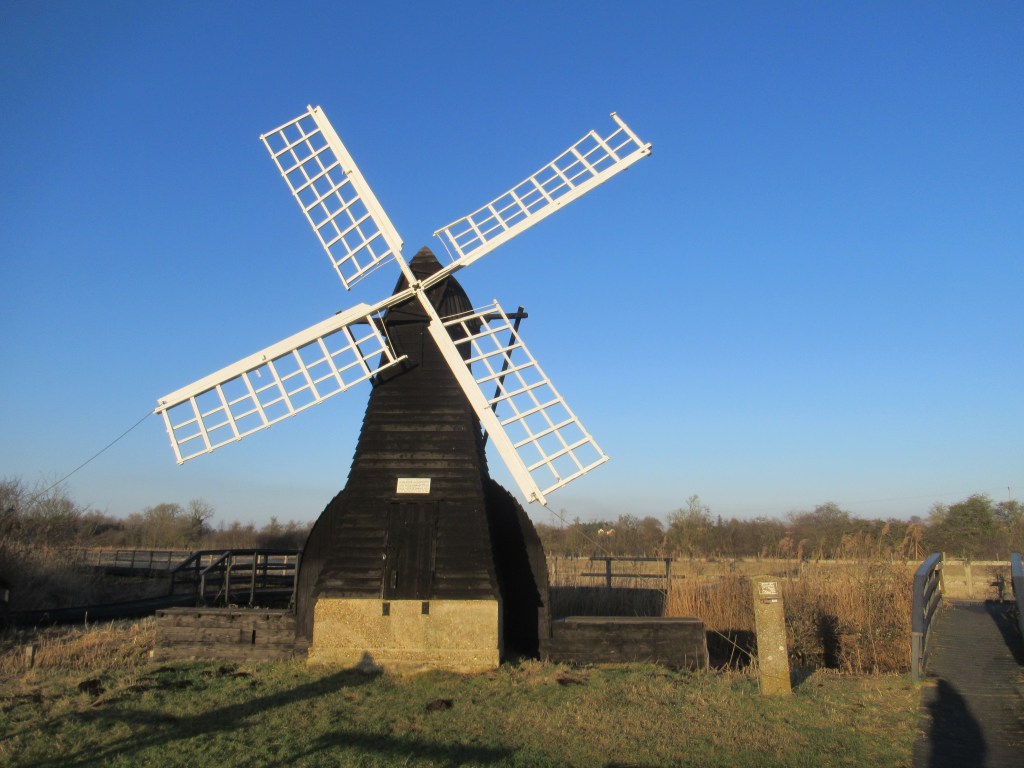
By late morning the day has warmed considerably and now feels somewhat spring-like, but fortunately the mud remains mostly frozen. I eat an early lunch on a bench at the top of a mound, with a good view over the flat landscape. Afterwards I continue a slow, relaxed amble along various pathways, heading eventually to the visitor centre where I stop for a coffee. The centre has a healthy population of House Sparrows, and these chirpy characters are always hanging around near the outdoor tables. Eventually one of the females plucks up the courage to land on my table in a futile search for crumbs. After hopping around cheerfully for a while, she flies back to the hedge, only to keep returning to the table. She spends so long at my table that I begin to feel like we’re on a date. She has even gone to the effort of wearing jewellery – she has been ringed (or banded) and wears a bracelet on her right ankle. This is how I know it’s the same bird each time, and that I’m not in some kind of spuggie speed-dating scenario. I feel bad for her because I’m only drinking coffee and have no food. I don’t even have any sandwich crumbs to offer her. Like all my previous partners, she eventually finds me disappointing and goes off to try her luck elsewhere.
I too move on for a quick look along the woodland trail. In a meadow near the visitor centre four or five Muntjac Deer are grazing, completely unconcerned by the people passing by.
As the afternoon starts turning to dusk and the temperature starts to drop again, I position myself for the grand finale of a winter’s day at Wicken: the harrier roost! In my early visits to the reserve, this was primarily a Hen Harrier roost. Like the Short-eared Owls, Hen Harriers breed on Britain’s uplands and spend the winter on lowland marshes. Unfortunately for them, they tend to favour the open heather moorlands of grouse-shooting estates, where they prey on the chicks of Red Grouse. This puts them in the gunsights of landowners and their gamekeepers. It has been estimated that the moors of northern England hold enough suitable habitat for 200+ pairs of Hen Harriers, but in recent decades the number of pairs has rarely reached double figures due to their illegal killing. Harriers fitted with satellite transmitters as part of research programmes have inevitably met their demise over grouse moors. Due to the remote locations where this happens, the crime is hard to prove, but the pattern is obvious.
The situation in Scotland, Wales, and the Isle of Man is much more optimistic, and even in England there is now some hope for the future. In 2022 the encouragingly large number of 49 nests were recorded in England, with 34 successfully raising chicks. 119 chicks fledged from English Hen Harrier nests last year, making it the first year with a treble figure count for over a century. So hopefully the tide is finally turning.
Conversely, the Marsh Harrier has been a massive success story. From a single nest on the Suffolk coast in the early 70s, its numbers have slowly increased until it is now a common raptor in East Anglia, as well as on other wetlands throughout Britain.
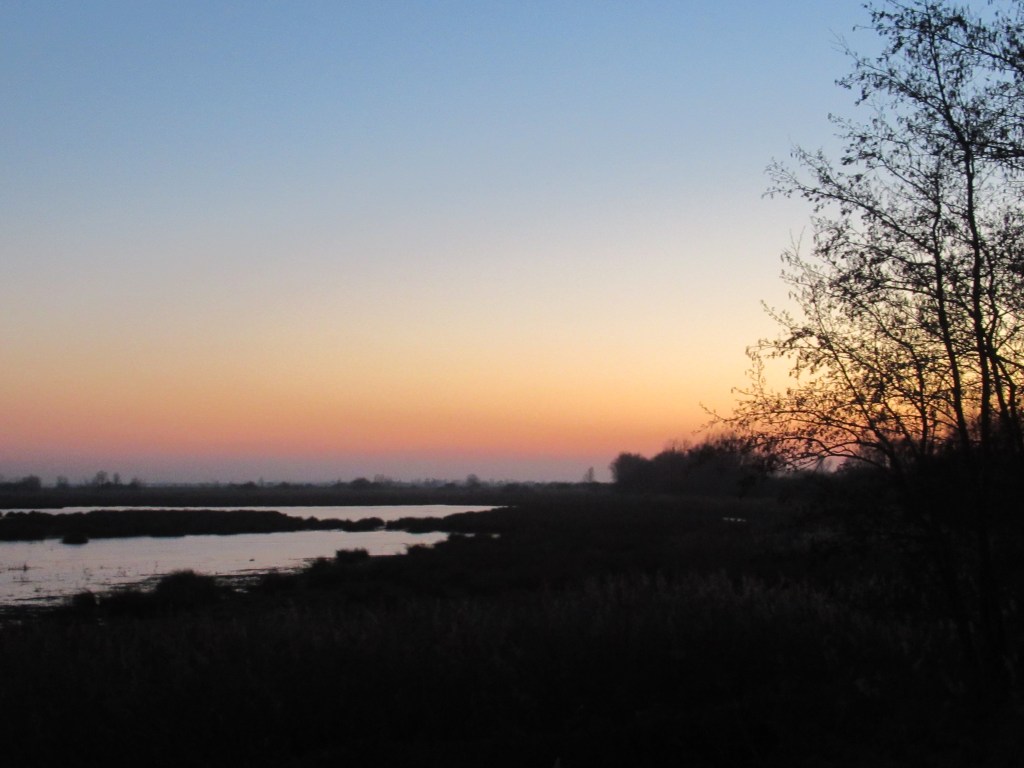
The boardwalk trail, which would normally be the place from which to observe the roost, is closed due to icy conditions, so I find another vantage point elsewhere. The views are more distant, and the roosting area can’t be seen properly but, as dusk sets in, I still get good views of the Harriers drifting in towards their night-time sanctuary. As expected, it’s mostly Marsh Harriers, with at least twelve drifting in low on V-shaped wings, but eventually a single male Hen Harrier arrives and flies back and forth a couple times before being lost from view. Slimmer and more elegant than the bulky Marsh Harriers, a male Hen Harrier is a stunning bird, with ghostly-pale grey and white plumage that really pops against the brown backdrop of the winter fens. The females and juvenile males, collectively known as ‘Ringtails’, are brown with a bright white band around the base of the tail. The last time I visited this roost was in January of 2020, just before the first lockdown. On that occasion I saw three males and two ringtails – an excellent showing for recent times – but tonight I must be content with just the one.
Also at the roost site, I see a male Sparrowhawk drift low over the fen, four Common Snipes rise up and fly off into the distance, and a handful of brightly-coloured Bullfinches call quietly from the shrubby areas. Then it’s time to start heading home. It’s another cold, cloudless night and I’m treated to a fantastic display of stars across the vast fenland sky.
 Vole Explosion
Leave a comment